Here is something I find genuinely strange. Information about money has never been cheaper or easier to get. And yet lottery tickets still sell, astrology apps keep growing, and people still act on a stock tip from someone they barely know.
So why do people still buy the ticket, or follow the tip? The usual answer is that they do not know any better. Nobody has sat them down and told them the odds.
If that were really the reason, all of this should be dying out by now. The odds have never been easier to look up. It is not dying out.
So one of two things is true. Either the information is not reaching people, or it is reaching them and answering a question they were never asking.
I think it is the second one. If so, a lot of what gets built in finance is solving the wrong problem. We keep making information better and faster, for people who were never short of it.
The lottery is the best place to check this, because it is the one case where you cannot say people do not know. If people play because nobody told them the odds, then telling them should stop it. The odds are public and easy to find. It changes nothing.
A lottery ticket is one of the few financial products where you can know, exactly and in advance, that the maths is against you.
Nothing about it is hidden. Whoever runs the lottery collects all the money from ticket sales, keeps a cut, and pays out the rest as prizes. So everyone playing, taken together, always gets back less than they put in. That is not a trick. It is the design, and it is printed on the box.
People buy them anyway — including people who could explain all of that to you perfectly well.
So ignorance cannot be the whole story. Something else is being bought.
My guess is that people are not buying a chance to win. They are buying the days before the draw.
For very little money you get a few days of maybe. Maybe you leave the job. Maybe you help your parents. Maybe the whole shape of your life is different by Sunday. You know it almost certainly will not happen, and you get to think it anyway. That is worth something, and the ticket is cheap.
So the strange thing was never that people buy tickets. It is that we keep explaining the purchase with probability, when probability was never what they were paying for.
Here is the clearest way I can put it. A weather forecast tells you it will rain on Saturday. What you actually wanted was for it not to rain. A better forecast — faster, more accurate, more personal — is not a smaller version of granting that wish. It is a different thing entirely, and no amount of it ever turns into the other one.
Information and reassurance are not substitutes. That is the whole idea, and the rest of this follows from it.
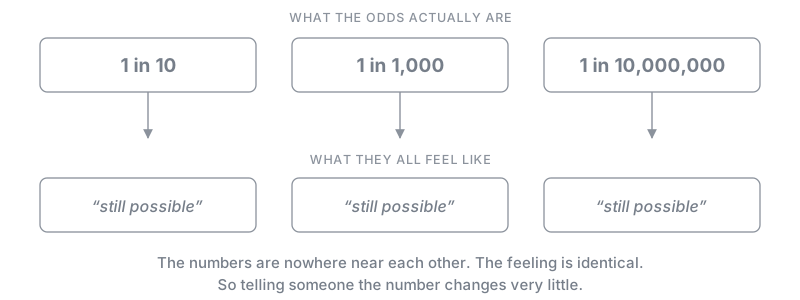
Some of this is just how our minds handle numbers. Kahneman and Tversky showed that we are bad at very small chances. One in several million does not land as almost never. It lands as small — and small still feels possible.
That is real, and it explains part of the pull.
But it does not explain all of it. Tell someone the true odds, watch them agree with you completely, and watch them buy the ticket anyway. The belief was never the thing doing the work.
Now the part I keep turning over, which is what any of this means for AI.
Until recently, a good story about your financial future was hard to come by. You needed a newspaper column, a tipster, a confident friend, an astrologer — someone who had to be found, paid, or listened to. The limit was never how many people wanted one. It was that stories had to be made one at a time, by hand.
That limit is gone. A language model can produce endless fluent, specific, plausible narrative about why this particular stock is about to move, tuned to what you already half believe, at no real cost, at three in the morning. Everything that made a tipster convincing is exactly what these systems produce most easily: confidence, detail, and a reason that sounds like a reason.
I do not think that is a flaw in them. It is what fluent writing is.
So my worry is not that AI will give people bad financial answers. It is that AI can serve the thing people actually want — a story that makes an uncertain future feel handled — better than anything before it, while looking exactly like the tool that was supposed to replace that want. This is reasoning, not evidence. I have not seen it measured, and I am not sure how you would measure it cleanly.
Now the case against me, which I think is a decent one.
Maybe a free story is safer than the old kind. The old way of getting one cost you something. You paid a tipster, or you bought the ticket, or you put money into the stock he was excited about. An AI costs nothing and takes nothing. If people can get the feeling they were after just by reading, some of them might never place the bet at all.
In that version, the cheap story drains the need instead of feeding it. That is close to the opposite of what I just argued, and I cannot rule it out.
I might also be too quick to dismiss plain facts. Some of what looks like wanting a story is ordinary confusion, and confusion really does clear up when someone explains things well.
So where do I end up? Narrower than where I started, but holding it more firmly.
If a product answers an emotional question while claiming to answer an informational one, then accuracy is the wrong measure of whether it is working. And accuracy is very nearly the only thing we know how to measure. A tool can be right about the market and still be doing, for the person holding it, exactly what the lottery ticket does.
I do not think that is necessarily bad. I think it is mostly unmeasured — and being unmeasured is how it stays invisible.