I’ve been trying to work out what “retirement” will mean if AI changes the shape of a working life, and somewhere in the middle I realised the question I started with was the wrong one.
The word assumes a particular shape to a life. You earn for about forty years. Then you stop. Then you live another twenty or so on what you set aside along the way. And you know, roughly, when the stopping happens.
Every retirement calculation rests on that shape. Forty years of saving has to cover twenty years of spending, which sounds tight, and it only works because money set aside early keeps growing the entire time it sits there. The same amount saved at twenty-five does far more work than it does saved at fifty. Not a little more. A lot more.
So two things are doing the heavy lifting: the early years, and the fact that you know when the end is. Change the shape of a working life and you change both.
So what would “AI compresses a career” actually mean? There are two versions, and they point in opposite directions.
In the first, the same money arrives in fewer years. That does not break retirement planning. It makes it easier, because money that arrives early has the longest time to grow. A short, well-paid career is a good problem to have.
In the second, the career does not shrink. It breaks apart. A skill you spent ten years building stops being worth much, so you start again around a different one. Your earnings drop, recover, and drop again, on a timetable you do not control. You might earn the same amount over a lifetime. The shape would be unrecognisable.
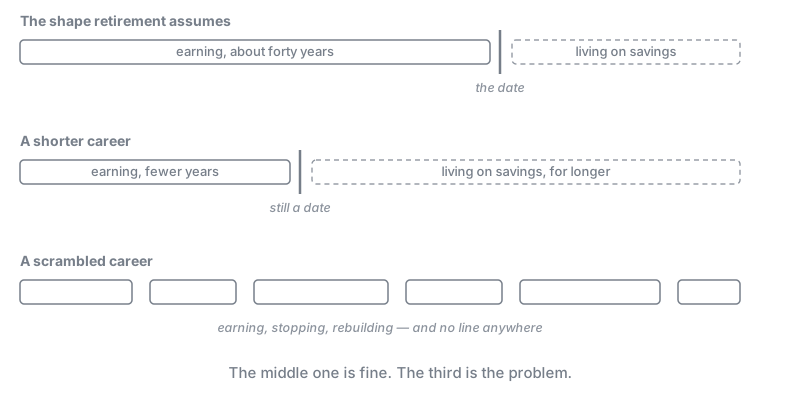
I think the second is more likely, and this is reasoning rather than evidence.
Here is why. What I can actually watch happening is not whole jobs vanishing. It is the valuable part of a job moving. Something that used to take skill and years to learn becomes cheap, and the part that still pays well shifts somewhere else in the same job. Nobody gets laid off. The ground just moves under them.
That is churn, not a clean exit. And churn is what makes an income unpredictable rather than simply short.
So what breaks is not the length of a career. It is the predictability of one. Any retirement plan is really a forecast, and a forecast needs a shape to extend forward. Churn takes the shape away and leaves the total roughly where it was.
Here is the part I actually care about, and it is psychological rather than financial.
A date does a lot of work. People are bad at giving something up now for something later, and the further off “later” sits, the worse they are at it. A date fights that. It turns a vague intention into a countdown, and marks the day the saving stops and the thing you were saving for starts.
Take the date away and retirement stops being a moment you arrive at. It turns into a number in an account, higher some years and lower others, that is never quite finished. There is no last day of work. And nobody celebrates reaching a number that could drop again next year.
My guess is that people save much worse when there is nothing to arrive at. That difference would never show up in a financial model, because it is not about money.
Now the best argument against all of this, which I find hard to dismiss.
The forty-year career ending in a pension is not an old idea. It is a recent one. Germany set up a state pension in the 1880s under Bismarck, payable at seventy, which was an age most workers back then never reached. Steady employment with a fixed retirement age lasted a few decades, in a handful of rich countries.
Here in India, most people work informally. No pension. No retirement date at all. They work as long as they can, then lean on family.
If that is the normal human arrangement, then AI is not destroying something ancient. It is ending a short experiment that most of the world never joined.
That does narrow what I want to claim. The date was never universal. But for the people who had it, it was doing two jobs at once, and only one of them was about money.
There is a hopeful version too. If AI makes people far more productive, the money part could get easier even as the shape gets messier. Comfortable with no schedule is a very different life from broke with no schedule. I do not know which one is coming.
So here is where I land.
The length of a career is the wrong thing to worry about. A short career carrying the same money is fine, maybe better.
Losing the date is the real change. Retirement was doing two jobs: paying for the years after work, and giving people something to aim at. If AI scrambles careers rather than shortening them, the second job disappears and the first stays exactly as expensive as it always was.
I do not know whether people end up richer or poorer. I do think they end up with nothing to aim at. And that loss will probably go unnoticed, because unlike money, it never shows up as a number.