I keep circling a specific worry about AI financial advisors, and I want to work through it slowly instead of just stating it, because I’m not sure it holds up.
Start with something I do think is true: markets need disagreement to function. Not chaos, disagreement. Think about what a trade actually is. You sell a stock and someone else buys it, because you think now is a good time to sell and they think now is a good time to buy. If you both felt the same way, there would be no trade at all. That disagreement is what lets you buy or sell when you want to, and it’s also how the price gets set. A price is just the current point of disagreement, the number where a buyer and a seller stop arguing.
Now suppose most people investing their own money are using an AI advisor. Not the same product necessarily — different companies, maybe different models underneath. But those models are built on a lot of the same training data, they’re built to sound careful and sensible in the same way, and they’re judged against the same idea of what a good answer looks like. So they’re different products, made in similar ways. Which brings me to the question I keep getting stuck on. If they’re all built in similar ways, do they end up saying similar things?
I don’t have a study to point to here. I haven’t seen one, and I’d guess it’s genuinely hard to study before enough people are using the tools to test it. So this is reasoning, not evidence, and I want to flag that clearly before going further.
Here’s how I imagine it working. Five people ask five different AI advisors whether they should be worried about this month’s inflation news. If those models learned from a similar body of financial writing, and were all trained toward careful, defensible answers, they might land on similar framings without any coordination at all.
This isn’t the usual kind of panic. Normally people copy each other because they can see each other — I sell because I watch you selling, or because the same frightening story is going round. What I’m describing is much quieter than that. Nobody sees anyone. Each person asks their own AI in private, gets roughly the same answer, and walks away sure they made up their own mind.
But a market doesn’t see how a decision felt. It only sees the orders. News breaks at a particular moment, and that moment is exactly when people reach for their advisor — so the questions all get asked at roughly the same time. If the answers come back roughly the same as well, then the orders arrive together and point the same way. And that is the whole of what following a crowd actually does to a price. It isn’t the feeling of being in a crowd that moves the market. It’s a lot of people trading the same thing, in the same direction, in the same hour.
So the two cases end up the same where it counts. A million people copying each other, and a million people each quietly asking their own advisor, produce the same result: orders piled up on one side and almost nobody on the other.
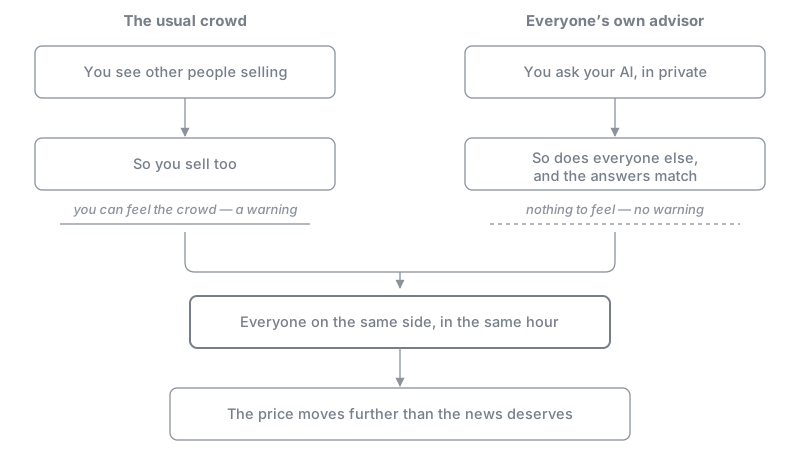
And it works just as well going up. If the advice turns hopeful at the same time, everyone buys at the same time. Everyone is on the same side again, with almost nobody left to sell to them, so the price runs further than the news deserves. That is how bubbles get built, not just how crashes happen. The direction doesn’t matter. What matters is that a lot of people end up on the same side of the trade at once, and none of them had to see each other to get there.
There’s a real precedent that makes me take it seriously: the crash of 1987. A number of institutions had independently adopted similar rule-based hedging strategies, which said, roughly, sell more as prices fall. Nobody colluded. Each firm was executing its own rational-looking plan. But because the rules were alike and widely used, the selling arrived all at once and drove the fall far past what any single firm intended.
The lesson I take from it isn’t “algorithms are dangerous.” It’s that similar reasoning, even when each instance of it is perfectly sensible on its own, can remove exactly the disagreement a market depends on — right at the moment it’s needed most.
If AI advisors produce a subtler version of that — not a mechanical sell rule, but a shared read on what a headline means — it would look strange from the inside. Nobody would feel like part of a crowd. Everybody would feel like they asked their own advisor and reached their own conclusion. That invisibility unsettles me more than the crowding itself.
Now let me argue against myself, because there’s a decent case that I have this backwards. Most people investing their own money today get no real analysis at all. They go on headlines, a tip from a friend, and instinct. But that already puts everyone on the same side at the same time. The headline lands, and a lot of people react to it together, in the same direction, within the hour. Today’s crowd isn’t spread out. It’s about as bunched up as it gets.
Next to that, a good AI advisor might actually push people apart. It knows something about your particular situation — your age, what you already own, how long you can wait. It might tell two people different things where a headline tells everyone the same thing. If that is how it plays out, then my worry is upside down, and these advisors would be making markets steadier rather than shakier.
I don’t know which effect wins. It probably depends on details I can’t reason my way to from here — how many genuinely distinct models end up mattering, how much the advice is personalised rather than generic, whether asking the same question twice even gives you the same answer.
One thing does make me slightly calmer. If this kind of copying becomes visible and there’s money in betting against it, capital will show up to do exactly that — much as strategies emerged after 1987 to anticipate that wave of selling. A correlated failure that people know about tends to get traded away. It’s the undetected one that does the damage.
So where does this leave me? I still don’t know whether AI advisors will make markets steadier or shakier. I’ve argued both sides here and I think both are genuinely open.
But the psychology tells me something the market argument can’t, and it’s this. Of the two ways I could be wrong, one would be much harder to catch than the other.
If AI advice does end up putting everyone on the same side, nobody would notice while it was happening. An ordinary crowd announces itself. You can see the queue forming, feel the rush, hear everyone talking about the same thing — and that feeling is a warning, one that makes some people stop and check themselves. This crowd would send no such signal. Each person would be alone with what felt like a private conversation, and would feel more sure of the decision, not less, precisely because it felt like their own.
That’s the thing I’d actually conclude, and it’s a modest claim. Not that this will happen. Only that if it does, the warning we normally rely on to spot a crowd — that faint discomfort of doing what everyone else is doing — is the one thing that won’t be there. So it would have to be looked for on purpose. Waiting to feel it would not work.