Someone spends a month deciding to put money into something. They read about it, ask two friends, sleep on it, and finally do it on a Tuesday. Six weeks later the price is down about a tenth, and the whole thing is undone in under a minute, on a phone, in a lift. The decision to go in took a month. The one to come out took a lift ride.
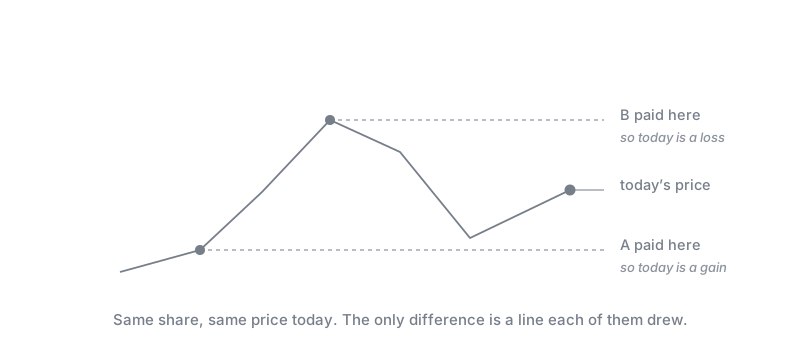
Half of that is not strange at all. A falling price is real information, and plenty of sales made under a loss are the right call. What I find odd is narrower. The reversal is so often triggered by one threshold — the price the person paid — which is a fact about their own history, not about the thing they own. Nobody else in the market can see it. Yet it decides whether an ordinary Tuesday feels like a crisis.
The best explanation I know comes from Daniel Kahneman and Amos Tversky’s work on how people weigh gains against losses. The familiar part is that a loss of a given size hurts more than a gain of the same size pleases. The part that gets mentioned less does more work here: once you are behind, you become more willing to take a risk, not less. Offer someone on level ground a coin flip for equal stakes and most will decline. Offer the same flip to someone who is down, where heads puts them back where they started, and it suddenly looks worth taking. Getting back to zero is worth more to us than the arithmetic says it should be.
That shows up in what people do. Individual investors sell what has gone up at a higher rate than what has gone down — Hersh Shefrin and Meir Statman named the pattern in the 1980s, and Terrance Odean found it in real brokerage records in the 1990s. Selling at a loss is what makes the loss final; while you hold it, it is still a story that might end another way. The panicked exit and the refusal to sell are the same instinct pointing opposite ways.
Now the part I care about, because I work on software that moves money. A money app is built on the assumption that the person using it knows what they want and should get it immediately: live numbers, a notification when something moves, the sell button two taps from a locked screen. Every one of those is good engineering by the ordinary standards of the trade. Together they make a machine that is at its most responsive at exactly the moment its user is least themselves.
So what would the other design look like? The oldest idea available is to have the calm version of a person leave instructions for the panicked one. Odysseus had himself tied to the mast before the sirens were in earshot, because he knew what he would want later and did not trust it. In software that means asking, in the calm month, what would have to be true for you to want out, and showing you your own answer in the lift. Not a lock, a mirror.
What is new is the detection. A model can now tell that a session does not resemble your usual ones — the hour, the speed, the hesitation. A product can know you are frightened before you would say so. This is reasoning, not evidence: I know of no study showing such a system leaves people better off, and I am not sure how you would run one honestly.
There is a good case against the whole idea. The panicking user is sometimes right, and a product that slows them down is claiming to know something about the future that it does not, while the cost of being wrong lands on them. Worse, the firm is not neutral. “Protecting you from yourself” and “keeping your money where it is” look identical from outside, and only one of them is worth anything to the firm. A design that hesitates only when you try to leave is not restraint. It is a business model with a psychology paper stapled to it.
The objection hands over a test, though. Friction that fires whenever a decision looks unlike the person who made the original one — on buying much more after good news as readily as on selling everything after bad — cannot be explained by the firm’s interest, because half of it costs the firm money. The honest version is the symmetric one, and symmetry is cheap to check from outside.
So: I no longer think the reversal is a defect to be prevented, and the product should not be trying to change anyone’s answer. It should be trying to make the minute in the lift resemble the month that came before it, then get out of the way. Whether anyone would use such a thing I do not know, since speed is most of what these products sell and the one that pauses loses to the one that does not. But that is a question about the market, not about whether the design is right. On the design I have stopped being undecided: if a money app has one moment of deliberate friction in it, and that moment only arrives when you try to take your money out, it was never built for you.